
Welcome to Yorkshire Kitchens
 Say hello to Yorkshire Kitchens, serving up fresh, tasty food across Yorkshire Learning Trust’s primary and secondary schools. At Yorkshire Kitchens, fresh, high-quality food comes first.
September menus are now live on meal selector, and families can now make bookings and payment via ParentPay with meals costing £3.20 per day. Click here to read the letter introducing Yorkshire Kitchens.
We are also pleased to announce our new Yorkshire Kitchens landing page is now live on the YLT website at https://www.ylt.org.uk/yorkshire-kitchens. This page includes links to the menus, allergen matrices, and the allergen/dietary request form.
Locally sourced produce
- Using locally sourced ingredients, Yorkshire Kitchens works with trusted suppliers, including bakers, wholesalers, and butchers, so that every meal is made with quality, flavour, and great nutritional value.
- Giving students plenty of choice and something to look forward to every day.
Created with students
- The Yorkshire Kitchens name and logo were created by the people who know our schools best: our students.
- Through a Trust-wide competition, students helped create a brand that celebrates great food, local roots, and our shared Yorkshire identity. The name and logo bring those values to life and reflect the creativity, pride, and community spirit of our schools.
Fresh, nutritious food every day
- Nutritious meals made with locally sourced ingredients.
- Trusted local suppliers deliver quality and freshness every day.
- Menus designed to support healthy growth to aid focus and energy throughout the school day.
- Carefully sourced, high-quality ingredients with great value for money.
- Menus developed using feedback from students across the Trust.
- Menus are updated often, so check back for what’s new.
School Uniform
Our School Uniform
Our full Uniform Policy can be found on our Policies Page.
Our school uniform is gender neutral. This is to ensure that all children are able to wear the uniform that they are most comfortable and confident in. A gender neutral uniform is equal in cost and is more sustainable as it gives more opportunities for uniform to be reused.
If you have any second hand uniform items that you would like to donate, please contact us.
Uniform may be bought from SchoolShop, Elvington, where items with logos are available. Alternatively, items may also be purchased from high street retailers and supermarkets
Daily Uniform
- Purple sweatshirt or cardigan, ideally with a school logo (not hooded)
- Trousers, skirts, culottes, shorts or pinafore dresses in black/navy/grey, gingham dresses in purple.
- Shirt, blouse or collared t-shirt in white or purple.
- Plain socks, tights and leggings in black/navy/grey.
- Smart shoes or boots in black/navy/grey, practical sandals with ankle straps. Pupils may wear open toed sandals at parent request.*
*Children’s shoes or sandals should be appropriate for school wear ie. suitable for them to run and play safely.
PE Kit
- Plain t-shirt in white.
- Sports shorts, tracksuit bottoms or sports leggings in black/navy/grey with minimal branding.
- Optional sweatshirt or school hoody for cooler weather
- Trainers or plimsolls suitable for indoor and outdoor PE.
- Named bag to keep PE kit in.
- When children are swimming, appropriate swimwear for the session.
Jewellery
- Pupils MUST remove ALL jewellery for PE and sport. Therefore, if new piercings are being considered, parents should ensure they are done at the start of the holidays to allow for the 6-8 week window for healing.
- Pupils will not be able to take part in PE lessons if they cannot remove their jewellery.
- This is in line with NYES Health and Safety Service guidance on playing sport.
- Watches may be worn but not those with recording devices.
Forest School Kit
Forest School sessions happen fortnightly for all year groups across the year, through all seasons.
- Long sleeved top & layers
- Full length bottoms/trousers
- Waterproof outer layers
- Appropriate footwear, e.g. wellies
- Change of clothing for after forest school.
You can order school uniform, including items with the school logo, from SchoolShop in Elvington. Items may also be purchased from high street retailers and supermarkets.

Early Years Foundation Stage at Wheldrake with Thorganby CE Primary School
At Wheldrake with Thorganby Primary School, we want every child to enjoy the best possible start in life. Our aim is to provide the support, encouragement and opportunities that help each child grow, thrive and fulfil their potential. We work closely with parents and carers to enrich learning and strengthen relationships, creating a nurturing and inclusive environment where children flourish academically, socially and emotionally.
We want children to experience the joy of learning through storytelling, creative play, meaningful exploration and warm, responsive relationships. Through purposeful play and thoughtful teaching, we help children develop resilience — encouraging them to keep trying, solve problems and take pride in their achievements.
Kindness and empathy sit at the heart of our practice. We model and promote kind words, caring actions and respect for others, helping children build strong friendships and a deep sense of belonging.
The Reception Team and Class Organisation
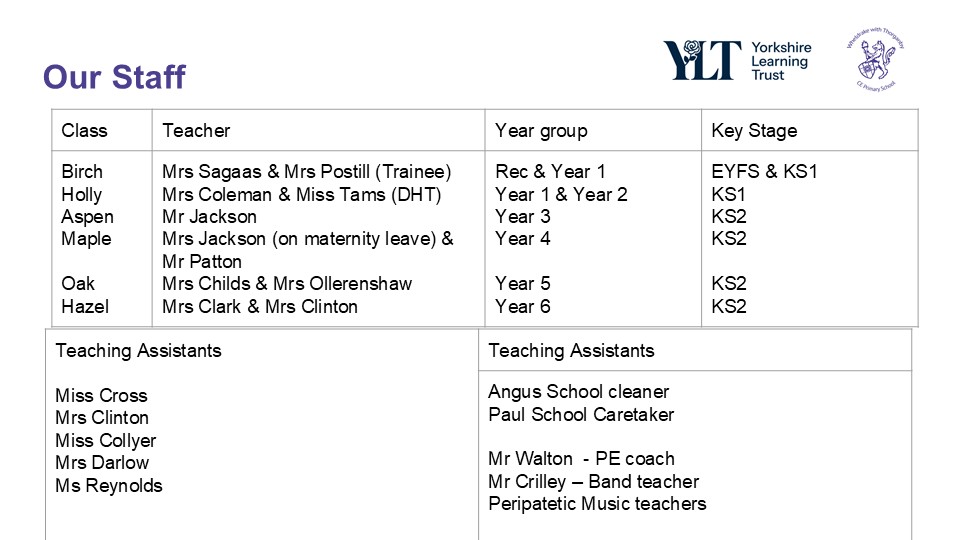
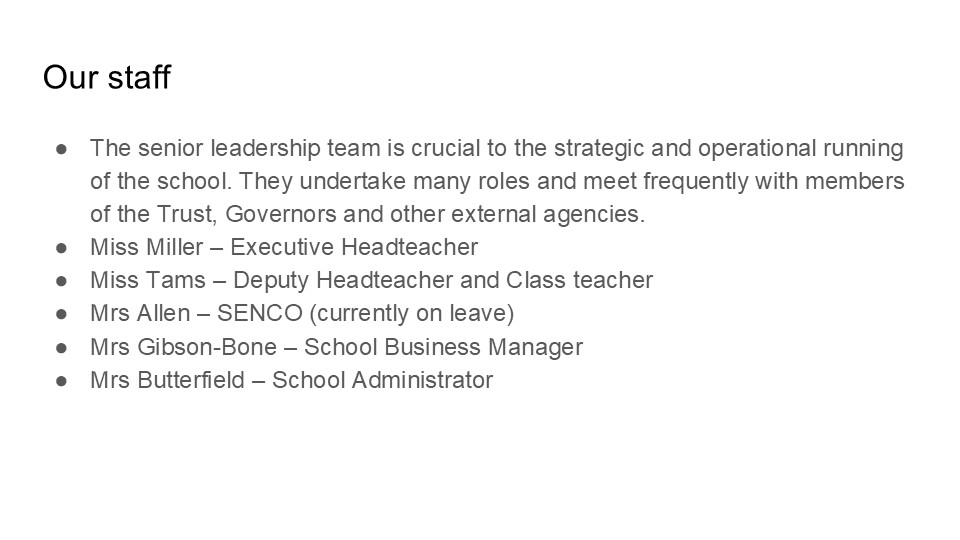
Mrs Gunhild Sagaas is our Reception class teacher, who will be supported by a teaching assistant daily. Mrs Sagaas is responsible for all planning, assessment, activities and will be your child’s key worker. She will report to you on your child’s progress at different points throughout the year. Our setting is fully inclusive and we will work with families, our SENDCo and Reception team to ensure we support our pupils as they start their school journey with us.
EYFS Curriculum Intent
At Wheldrake with Thorganby Primary School, our EYFS curriculum is designed to give every child the strongest foundations for learning by building on the nurturing, inclusive ethos at the heart of our vision. We want children to feel secure, valued and confident as they explore, play and learn, and our curriculum is carefully sequenced to help them develop the knowledge, skills and attitudes they need to thrive.
Our curriculum prioritises communication and language, early reading, self regulation and social development, recognising these as essential building blocks for future success. Through purposeful play, high quality interactions and thoughtfully planned learning experiences, children develop curiosity, resilience and the ability to solve problems — reflecting our commitment to helping them keep trying, celebrate achievements and fulfil their potential.
We choose rich stories, meaningful exploration and real life experiences to deepen children’s understanding of the world and strengthen their sense of belonging. Kindness, empathy and respect are woven throughout our curriculum, supporting children to build positive relationships and work collaboratively with others.
We want to provide a joyful, ambitious and inclusive curriculum that nurtures confident learners who feel proud of themselves, connected to others and ready for the next stage of their education.
Learning takes place both indoors and outdoors, and our provision follows the Early Years Foundation Stage Statutory Framework, found here: EYFS statutory framework for group and school-based providers
Four guiding principles shape our practice:
- A unique child
- Positive relationships
- Enabling environments
- Learning and development
These principles underpin everything we do, ensuring that every child is valued, supported and inspired.
The overarching aim of the EYFS is to help pupils achieve their full potential through the three characteristics of effective learning:
- Playing and Exploring
- Active Learning
- Creative and Critical Thinking
There are seven areas of learning and development that shape educational programmes in early years settings. All areas of learning and development are important and inter-connected. The three prime areas underpin the basic building blocks for development. These are:
- Communication and language
- Physical development
- Personal, social and emotional development
These prime areas are those most essential for your child’s healthy development and future learning. As children grow, the prime areas will help them to develop skills in 4 specific areas. These are:
- Literacy
- Mathematics
- Understanding the World
- Expressive Arts and Design
These 7 areas are used to plan each child’s learning and all activities will be suited to each child’s unique needs and interests. Children will work towards achieving Early learning Goals within these 7 areas. To see an overview of the ELGs click here: Early Learning Goals on one page.
Topics and Themes
We have developed topics for each term in Reception Class. These topics provide a starting point for our learning, with freedom to follow children’s interests and personalise learning to our setting, cohort and context. Our themes this year are:
Core focus | Additional Focus |
Marvellous Me | Families and people who help us in school |
Let’s celebrate | Light and dark |
People who help us | Animals |
Once upon a time | Easter |
Life in the garden | Mini beasts |
Under the sea adventures | Transition and transport |
Phonics and Early Reading
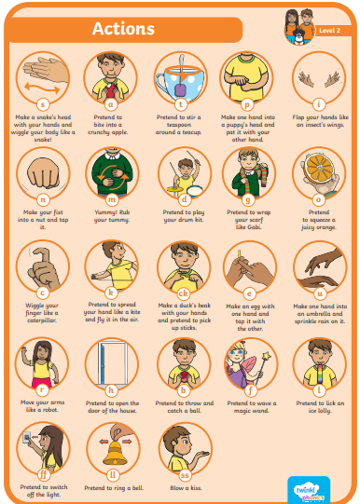 At Wheldrake with Thorganby, Reception follows Twinkl Phonics scheme and uses phonetically decodable books arranged in progressive book bands for reading.
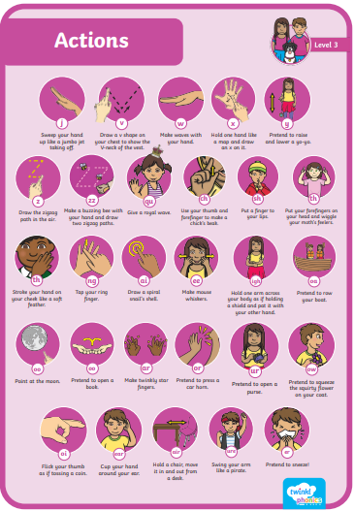
Daily phonic and reading sessions are taught throughout EYFS using the Twinkl Phonics scheme. To view the programme overview that shows the progression of GPCs and tricky words taught term-by-term in reception, please see here: Twinkl Phonics Level 2-4 Overview
To find out more about what is taught in each Level of Twinkl Phonics, useful terminology your child might use at home and tips for how you can support the children, please see here: Twinkl Phonics Handout for Parents and Carers
 Alongside phonics, children enjoy reading practice sessions at least twice per week. These small‑group sessions use fully decodable books matched to each child’s phonics stage. The sessions focus on:
- decoding (sounding out and blending)
- reading with fluency
- understanding what they have read
Children also have a weekly visit to our school library and take home a sharing story to enjoy with family, helping to build a love of stories and reading for pleasure.
Handwriting
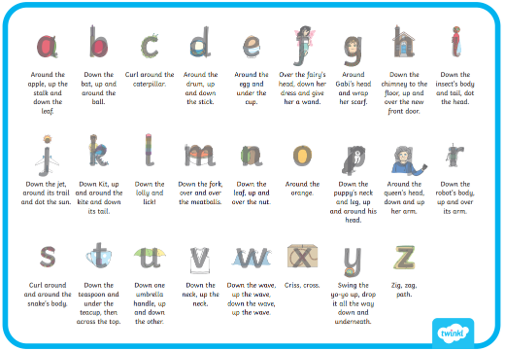
We teach handwriting through the Twinkl Phonics programme, following the same progression as our phonics teaching. Children learn to develop good writing posture, a secure and efficient pencil grip, and accurate letter formation using Twinkl’s clear and memorable handwriting mnemonics. Each grapheme is introduced in phonics lessons alongside its formation phrase, helping children build strong motor patterns and confidence as they write.
Handwriting is taught in a carefully sequenced order that mirrors the phonics phases, beginning with pre‑writing patterns, moving through lower‑case letter formation, and later introducing capital letters, digraphs, trigraphs, and words containing these graphemes.
Lessons follow a consistent structure:
- Reviewing prior learning
- Adult modelling using Twinkl’s formation mnemonics
- Multi‑sensory practice such as air writing, tracing and large‑scale patterning
- Guided and independent application
- Precise feedback to secure correct formation in long‑term memory
Wheldrake Pre-School
Based in Wheldrake within Thorganby School, Wheldrake Pre-School is an Ofsted-registered charity.
It offers a warm and welcoming setting, providing nurturing care and high quality education that inspires confidence, curiosity and a life-long love of learning.
The pre-school is a term time only setting offering either full day or morning sessions, and works in partnership with WOoSC to offer wrap around care between the hours of 8am and 6pm.
For session changes, finances and funding please contact Sandra, our Business Manager, on admin@wheldrakeplaygroup.co.uk
For any day to day queries please contact Vicki, our Setting Manager, on settingmanager@wheldrakeplaygroup.co.uk or give us a ring on 07415746466
You can find out more about the setting, including term dates, session times and fees, on the Wheldrake Pre-School website.
Wheldrake Out of School Club
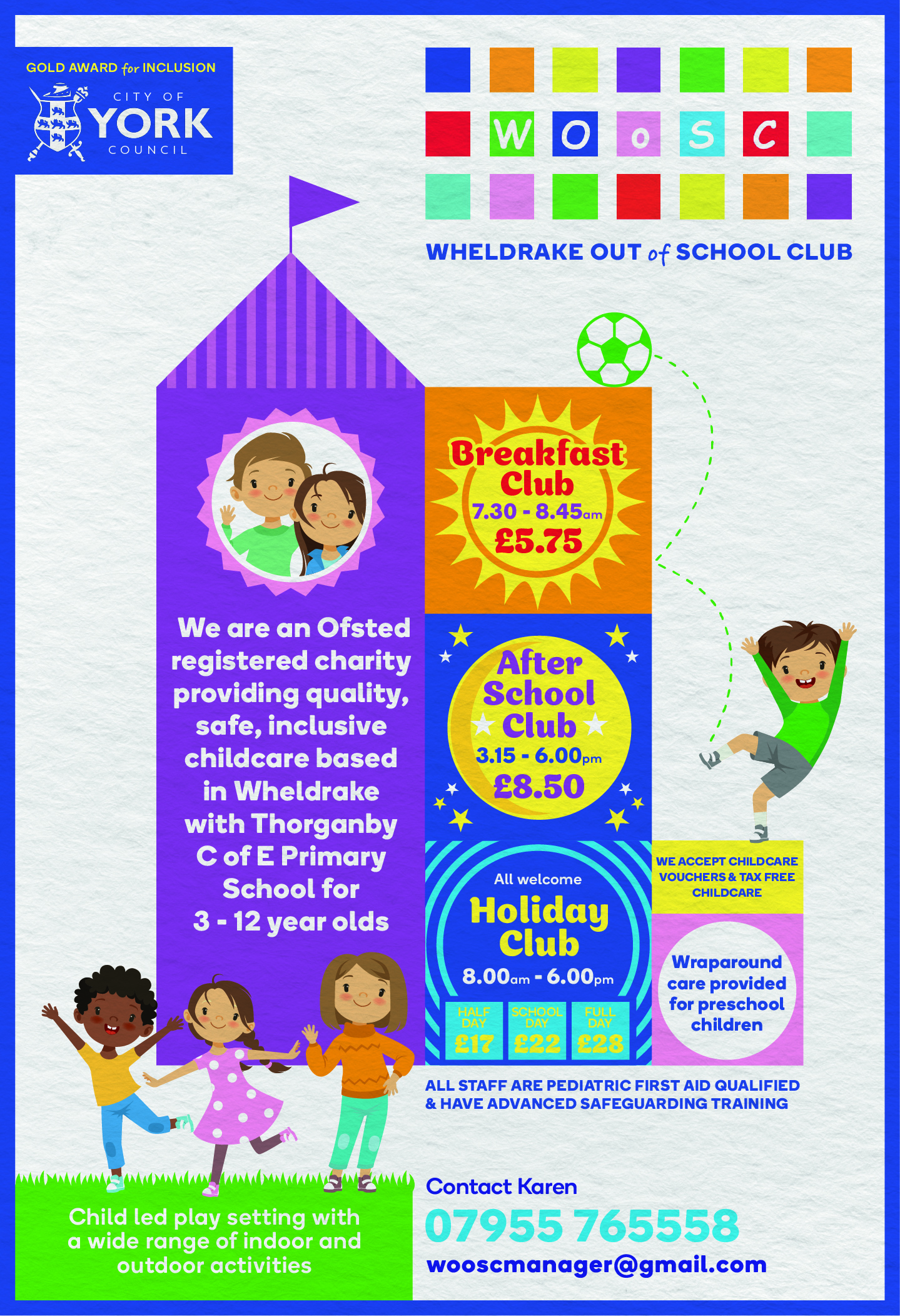
- Breakfast Club operates from 7.30am to 8.45am
- After School Club operates from 3.15pm to 6.00pm
- Holiday Club operates from 8.00am to 6.00om with half days, school days and full day booking possible.
Wraparound care for preschool children is available, working in partnership with Wheldrake Pre-School.
WOoSC can accept childcare vouchers and tax-free childcare payments.
For further information, please contact Karen in 07955 765558.