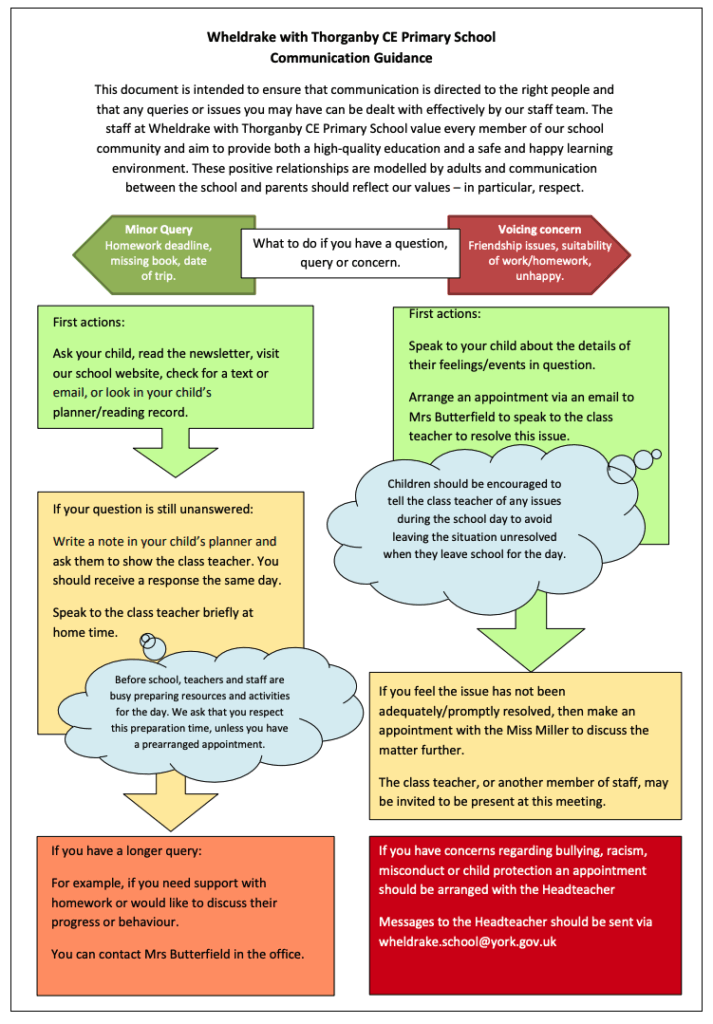
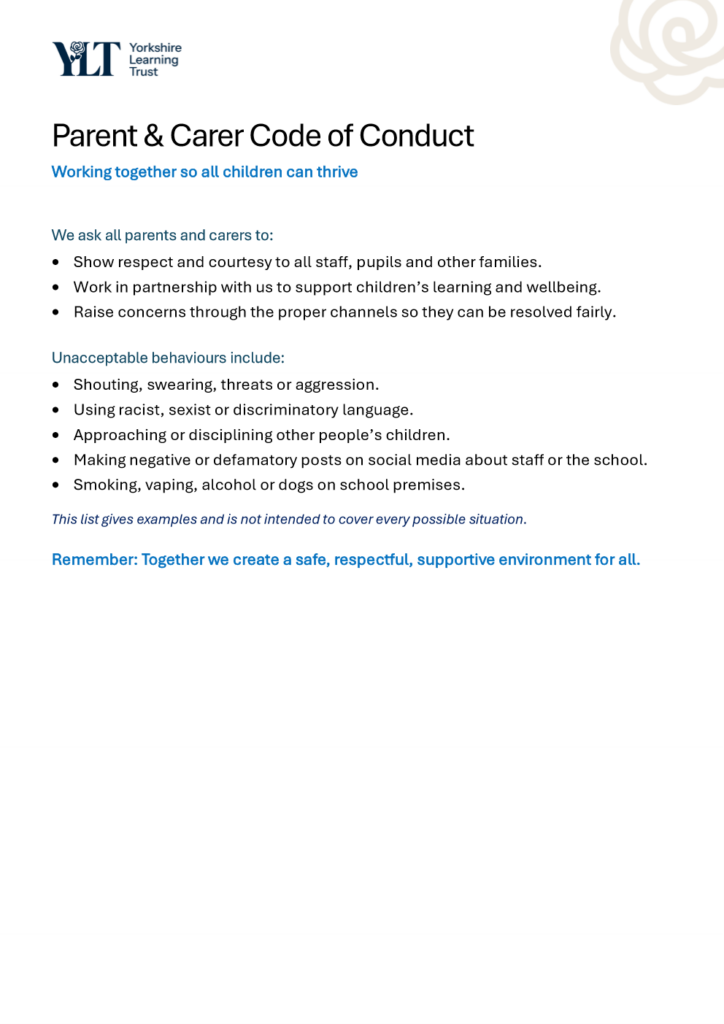
Parents & Carers

Communication Guidance

Click for a larger .pdf version

School Drop Off, Pick Up and Collections Arrangements

Entrance to school – Safety is of paramount importance and as a result we ask you to park safely and legally when dropping off or picking your child up from school. We appreciate that we do not have a car park but please consider walking where possible or using the layby to park and then walk your child to school. Entrance to school is from North Lane, through the pedestrian entrance into the playground.

If your child is coming to school on their bike or scooter can you, please ensure that they get off this once within school grounds and that they walk with it to place it in the bike rack. This it to ensure the safety of all our children, parents and visitors to our school.
The school day – The school day starts at 8.45am, with the pedestrian gate being opened slightly earlier. Children should be supervised upon arrival and wait in the playground for the Key Stage 1 and Key Stage 2 doors to be opened. Familiar adults will be at the door to welcome your child into school. As we have a soft start to the day the children have until 8.50am to enter the school building. If you are running late and the doors are closed, then please make your way to the main entrance where Mrs Butterfield will let you in.

School finishes at 3.20pm. Children in reception, Years 1, 2, 3 and 4 will be handed over to an adult familiar to the teacher. If someone else is collecting your child, then please notify either the class teacher or the office as soon as possible. Children in Years 5 and 6 may walk home on their own providing you have given consent. Please speak to Mrs Butterfield if you require a consent form. We will not allow children to go to the park to meet parents there.
Children who use the school bus will be met by a teacher and also taken back to the bus at the end of the day by a teacher or staff member.

If you are running late due to unforeseen circumstances, then please ring the school office as soon as possible so that we can take care of your child until you arrive. Please then pick them up from the main entrance.

Playtime is from 10.30 – 10.45am and the children use the playgrounds at the front of school. On some days the children are split into Key Stage 1 and 2 but on some days they can play together. This information is shared with the children each term.
Lunchtime is between 12 and 1pm. Children go into the hall in Year groups and the order varies each half term. All sittings have around 20 minutes to eat their lunch and a 40-minute playtime.

Term Dates and School Opening Hours

School holidays and training days for 2025-2026: Term Dates 2025-2026

School holidays and training days for 2026-2027: Term Dates 2026-2027

York Council page with all term dates for the next few years: Click here to find these on the CYC website

The offical start time of the compulsory school day is 8.50am.

The official end time of the compulsory school day is 3.20pm

Doors open from 8.45am for a soft start. 

The total time this amounts to in a typical week is 32.5 hours.

School Meals

We believe in providing our children with healthy, nourishing food because we think it’s important for their well-being. A good diet helps children be their best and perform well in everything they do. It’s especially important for their ability to focus, which affects how well they do in school.
 
We encourage all our children to have a school lunch because there are plenty of options to suit different tastes.
 
We’re happy to see our students bringing a variety of healthy packed lunches and snacks. We want to remind you that a good breakfast and a healthy snack during break time can really help your child’s learning in the morning. A balanced dinner also gives them energy for the afternoon until they go home or attend after-school activities.
 
We kindly request that you refrain from packing high-fat and high-sugar snacks in your child’s lunch. Additionally, we have students with nut allergies, so please be mindful of this when preparing snacks and meals for school. The EYFS and KS1 children receive fruit and vegetables every day, offered under the government initiative to provide all infants with free fruit and vegetables during the day.
 
As a precautionary measure, our school is a nut-free environment. Thank you for your cooperation in keeping all of our students safe.

School Lunch Menu

School dinners are available at a cost of £3.40 a day per pupil. The new menu started on Monday 23rd February, with the week 1 menu. You can click to enlarge the images below, or use these links for .pdf versions:

Ordering a school lunch

Our school uses ParentPay’s Meal Manager for parents and carers to order their child’s school lunch. This system helps parents and carers see what their children are eating and manage any food allergies or special diets.
 
All parents, including those whose children bring packed lunches, need to log in to ParentPay. Then, they can choose to order a hot dinner or pack a lunch from home. 
 
ParentPay can be accessed here:
 
Dinners must be ordered on ParentPay by Thursday of the week before. After that, the option to order a meal will be turned off. Please contact the school office if you need to amend the order after booking has closed. You can order meals ahead for a whole term. Meals will need to be paid for at the time of booking. If your child is bringing a packed lunch from home, you should log in to book this.
 
If your child is in Reception, Year 1, or Year 2, they will get free school meals. But you still need to order the meals on the system. If your child qualifies for free school meals in other years, you also need to order the meals online, but you won’t need to pay.
 

For more information, on how to book your child’s meal, please visit: Payer guidance – How to make a meal or event booking – ParentPay Group

Free School Meals and Pupil Premium

Free school meals are also available to families who receive certain benefits; you can find out more and apply online via the City of York Council website. We would strongly encourage any families who feel they may meet the criteria and may be entitled to this support to apply – including if your child is entitled to a meal under the universal infant free school meal initiative – as your child’s school will benefit from additional funding known as the Pupil Premium. 
 
If you qualify for free school meals, your school can provide a meal for your child straight away. Schools can then include the number of children who qualify for free school meals in their Census Day information, which they do in October. If schools do this, they receive the right level of funding from the government to support children who qualify for free school meals. This funding is called the Pupil Premium. For each child in primary school, the Pupil Premium payment is £1,385. Pupil Premium funding can be used to support your child in lots of different ways.
 
For example:
  • investing in extra resources to support teaching and learning
  • employing skilled and trained professionals to work with individual children, like speech therapists or Learning Mentors
  • Pupil Premium money must be used to help and support children.
 
Your child does not have to have a school meal, although one will be available free of charge at any time until your circumstances change and you no longer qualify. But the value of the meal is worth around £400 per year to you, and you could put the money you would spend on a packed lunch towards other things. Also, children will often eat meals at school if they see their friends having them. They often try different foods at school rather than at home.
 
The City of York Council is rolling out a Free School Meal Auto Enrolment Project. More details can be found here:

ParentPay

Parents and Carers can pay online for school meals, as well as trips using ParentPay.

You can find ParentPay here.

School Uniform

Our School Uniform

Our school uniform is gender neutral. This is to ensure that all children are able to wear the uniform that they are most comfortable and confident in. A gender neutral uniform is equal in cost and is more sustainable as it gives more opportunities for uniform to be reused. If you have any second hand uniform items that you would like to donate, please contact us.

Uniform may be bought from SchoolShop, Elvington, where items with logos are available. Alternatively, uniform may be purchased elsewhere.

Daily Uniform

  • Purple sweatshirt or cardigan with or without a school logo.
  • Trousers, skirts, culottes, shorts or pinafore dresses in black/navy/grey, gingham dresses in purple.
  • Shirt, blouse or collared t-shirt in white or purple.
  • Plain socks, tights and leggings in black/navy/grey.
  • Smart shoes or boots in black/navy/grey, practical sandals with ankle straps. Pupils may wear open toed sandals at parent request.*

*Children’s shoes or sandals should be appropriate for school wear ie. suitable for them to run and play safely.

PE Kit

Pupils attend school in their PE kit instead of their uniform on their PE days.

  • Plain t-shirt in white.
  • Sports shorts, tracksuit bottoms or sports leggings in black/navy/grey with minimal branding.
  • Trainers or plimsolls suitable for indoor and outdoor PE.

Please note that pupils MUST remove their own jewellery for PE and sport. Therefore, if new piercings are being considered, please ensure they are done at the start of the Summer holidays to allow for the 6 week window for healing. Pupils will not be able to take part in PE lessons if they cannot remove their jewellery. This is in line with NYES Health and Safety Service guidance on playing sport. 

Download our school uniform list here.

You can order your school uniform here at SchoolShop in Elvington.

Our uniform policy can be found here.

Early Years Foundation Stage at

Wheldrake with Thorganby CE Primary School 

In Reception we follow the statutory framework for the Early Years Foundation Stage (EYFS). Here is a brief guide to what this means for you and your child.

The Reception Team

Class Organisation

Mrs Gunhild Sagaas is our Reception class teacher, who will be supported by a teaching assistant daily. Mrs Sagaas is responsible for all planning, assessment, activities and will be your child’s key worker. She will report to you on your child’s progress at different points throughout the year. Our setting is fully inclusive and we will work with families, our SENCO and Reception team to ensure we support our pupils as they start their school journey with us.

Learning

At Wheldrake with Thorganby CE Primary School, the children are at the heart of all we do. We involve the children in their learning by planning with the children and following their interests whilst teaching them the foundational skills they need. It is our vision to support children as they become independent thinkers and learners. Our child centred, play based curriculum supports this with continuous provision play, adult led, child led and whole class teaching. We have a door from the classroom to the outdoor area, so the children have regular opportunities to take their learning outside.


The three characteristics of effective teaching and learning are:

* Playing and exploring – children investigate and experience things, and ‘have a go’.

* Active learning – children concentrate and keep on trying if they encounter difficulties, and enjoy achievements.

* Creating and thinking critically – Children have and develop strategies for doing things.

The Early Years Profile

At the end of your child’s first year in school, the class teacher will complete the Early Years Profile which provides us with a well rounded picture of progress made.

There are seventeen Early Learning Goals that development is assessed against. A judgement will be made about whether your child is meeting or not yet meeting expected levels for their age.

This profile will be shared with you at the end of the year. To find out more please visit:

Early Years Foundation Stage Statutory Framework pdf link


The Curriculum

The EYFS curriculum consists of 7 areas of learning and development for all children from birth to 5yrs. The areas are equally important and interconnected.

The three Prime areas are:

* Communication and Language – Developing a rich language environment through speaking and listening in a range of situations.

* Physical Development – Developing co-ordination, control and movement alongside an understanding of healthy living.

* Personal, Social and emotional Development – Developing positive self images and respectful relationships with others, learning how to manage feelings and understanding appropriate behaviour.

These are Prime areas because they establish the building blocks for children’s capacity to learn, from relationships and thrive.


The four Specific areas are:

* Literacy – Learning to link sounds and letters and beginning to read and write.

* Mathematics – Developing counting, understanding and using numbers, calculating and exploring shape space and measures.

* Understanding the world – Making sense of their physical world and community through exploring people, place, technology and the environment.

* Expressive arts and design – Exploring a wide range of media and materials in art, music, dance, role play and design technology.

The three Prime areas are strengthened and developed within these four Specific areas.

Assessment

Assessment is an on-going process and is an important part of each child’s learning and development. At Wheldrake with Thorganby CE Primary School we observe the children at play and during adult led and child led activities to understand their level of achievement and interests.

We use these observations to shape future learning experiences and take guidance from Development Matters, which is non statutory. Our notes, copies of work and  photographs contribute to teacher assessments and we use an online learning journey on Seesaw  to capture WOW moments.

Teaching and Learning

In our Reception class, we follow a child led approach. Through observing and supporting the children at play, the adults are then able to plan lessons and enhance areas of provision to link to the children’s current interests and next steps. English and Maths lessons are themed where possible around stories or relevant events or celebrations. Development Matters is used to track pupils progress and at the end of the year the children are assessed against the early learning goals.

Phonics, handwriting and Reading

Pupils in reception have a daily phonics session, which is through a DfE approved provider Twinkl Phonics. Phonics is taught in levels, where pupils learn all the letters and sounds. Parents are provided with a summary sheet at the end of week, focusing on the phonics sound and level.

Children are supported in their fine and gross motor skills, mark making in their play and then early letter and word writing. Handwriting and early writing is taught through Twinkl Phonics. As a school, we have a cursive handwriting policy, which starts in Year 1 through Letter Join.

As the children learn new sounds, their ability to recognise those sounds and blend those sounds into words increases. Pupils read daily as part of their phonics sessions and guided reading sessions. We have Twinkl Phonics Rhino Readers that support the sounds that the children have been learning. When they are ready, pupils will take a reading book to read at home. Reading with your child at home is vital in supporting them to practice the reading skills we have taught them at school.

Mathematics and numbers

Our school use White Rose Maths to support the planning and teaching of maths in all year groups. Lessons are adapted and supplemented depending on the theme and the knowledge of the children. Number work is practical and active where possible.

Parents/carers

We value your contributions to your child’s learning and encourage you to share any milestones achieved at home with us.

We host Parent Enrichment sessions termly, where you can come into school and spend time with your child in their setting.

To find out more, please visit our school website or contact us:

www.wheldrakewiththorganbyschool.co.uk

01904 553422

Wheldrake.school@york.gov.uk

Wheldrake Pre-School

Click to visit the pre-school website

Based in Wheldrake within Thorganby School, Wheldrake Pre-School is an Ofsted-registered charity.

It offers a warm and welcoming setting, providing nurturing care and high quality education that inspires confidence, curiosity and a life-long love of learning.

The pre-school is a term time only setting offering either full day or morning sessions, and works in partnership with WOoSC to offer wrap around care between the hours of 8am and 6pm.

For session changes, finances and funding please contact Sandra, our Business Manager, on  admin@wheldrakeplaygroup.co.uk

For any day to day queries please contact Vicki, our Setting Manager, on settingmanager@wheldrakeplaygroup.co.uk or give us a ring on 07415746466

You can find out more about the setting, including term dates, session times and fees, on the Wheldrake Pre-School website.

Wheldrake Out of School Club
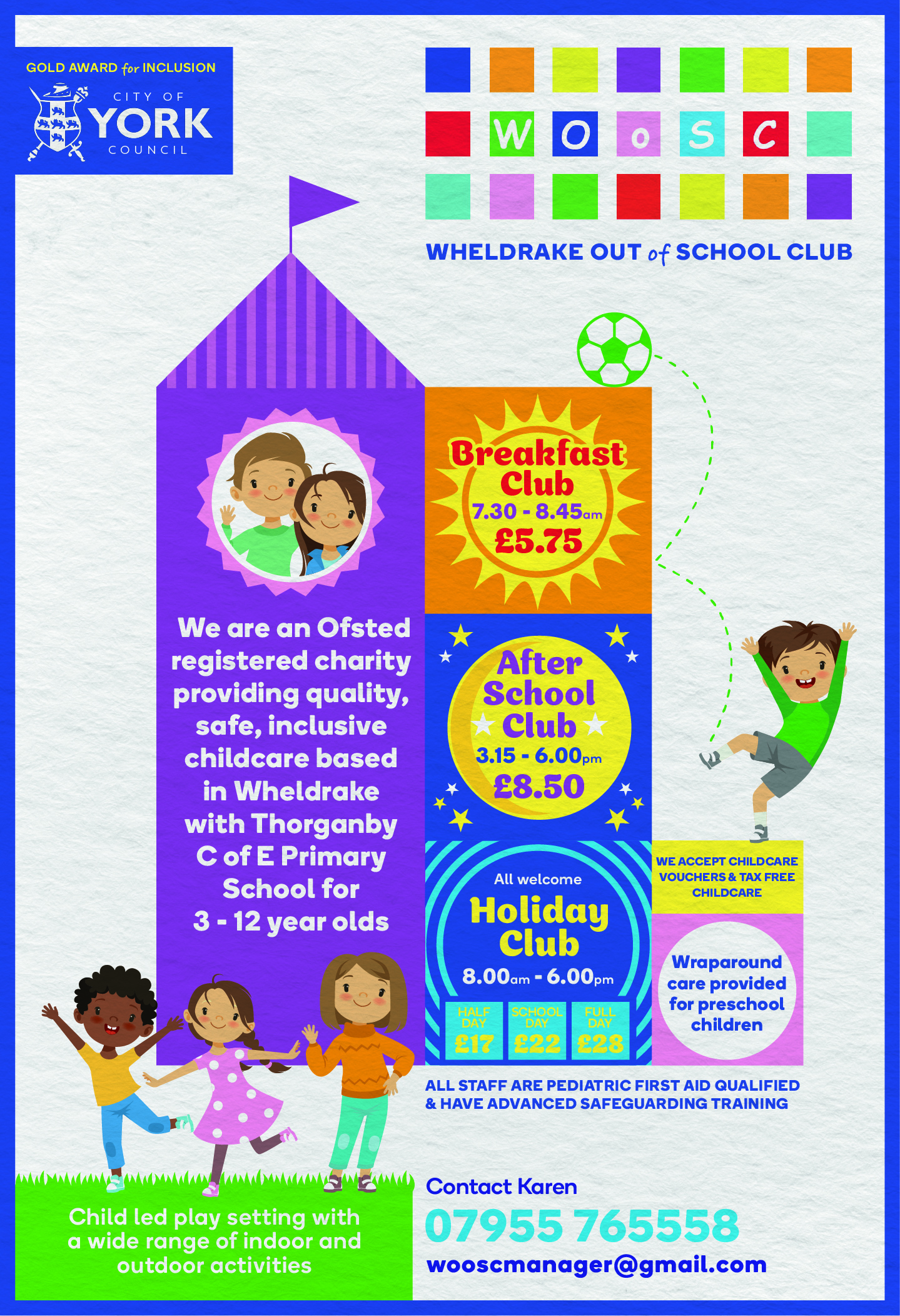
Click to enlarge
 
The Out of School Club is an Ofsted registered charity, providing safe, inclusive childcare for 3 to 12 year olds, and is based in our school.
 
  • Breakfast Club operates from 7.30am to 8.45am
  • After School Club operates from 3.15pm to 6.00pm
  • Holiday Club operates from 8.00am to 6.00om with half days, school days and full day booking possible.

Wraparound care for preschool children is available, working in partnership with Wheldrake Pre-School

WOoSC can accept childcare vouchers and tax-free childcare payments.

For further information, please contact Karen in 07955 765558.
SEND at our School

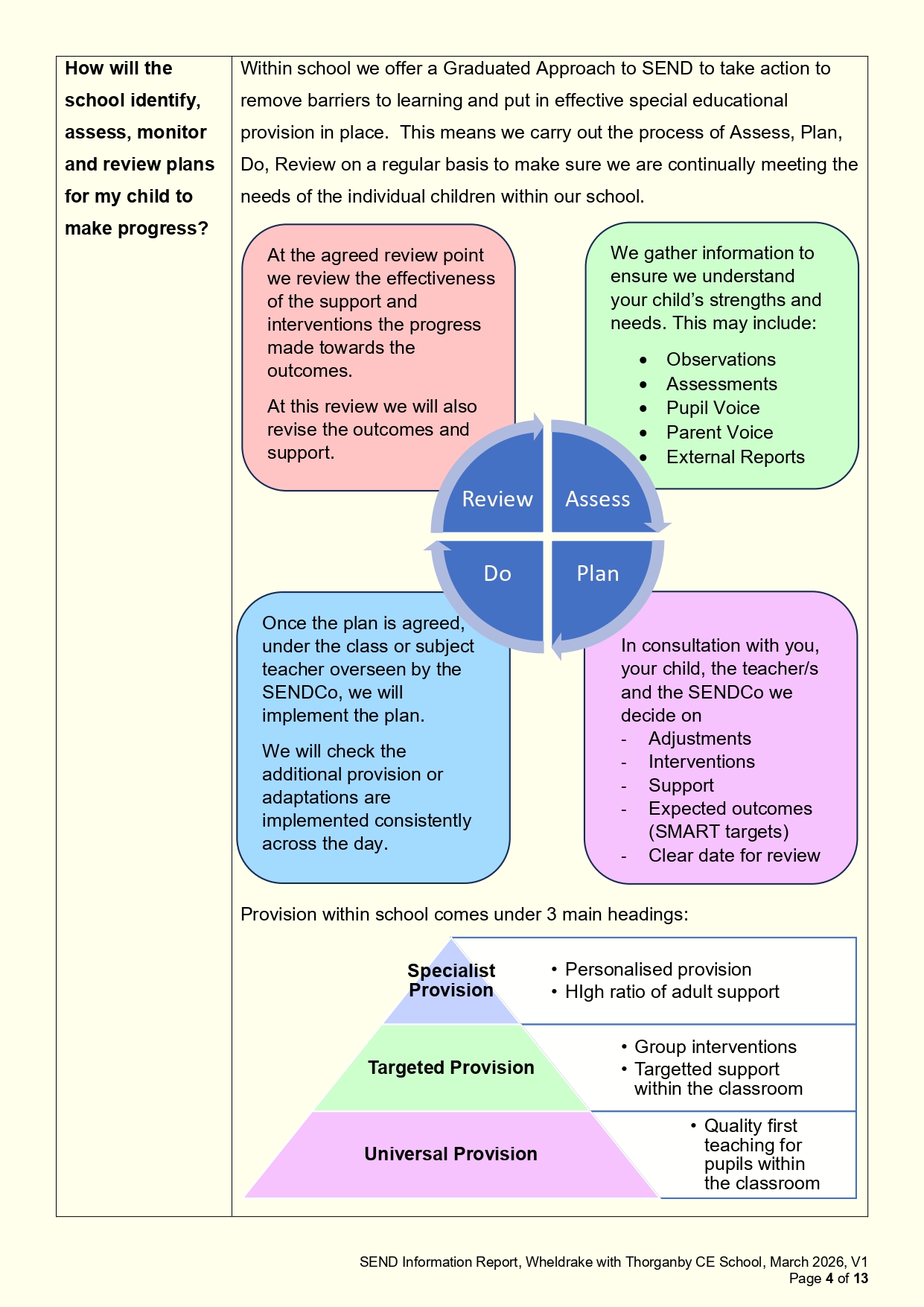
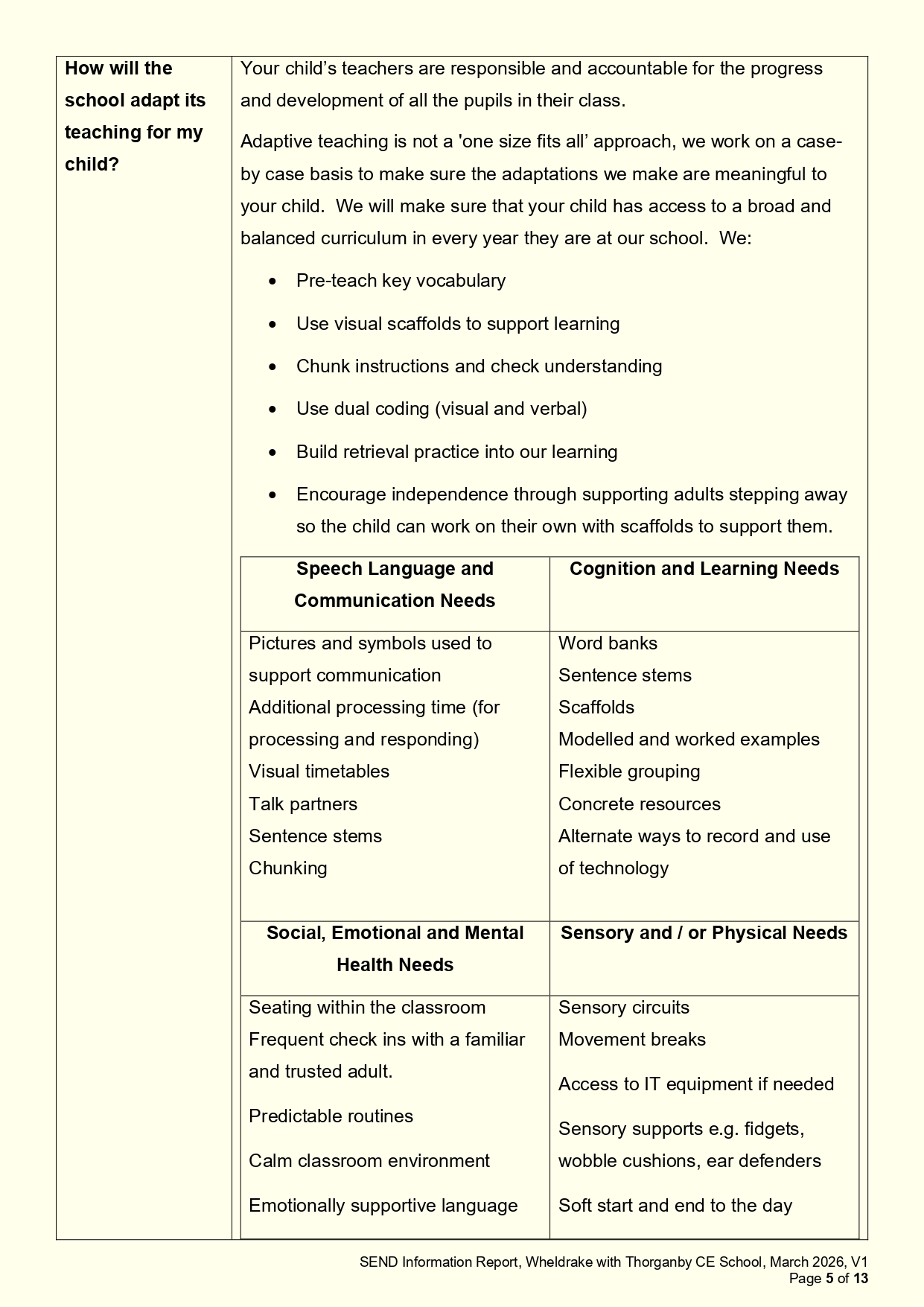
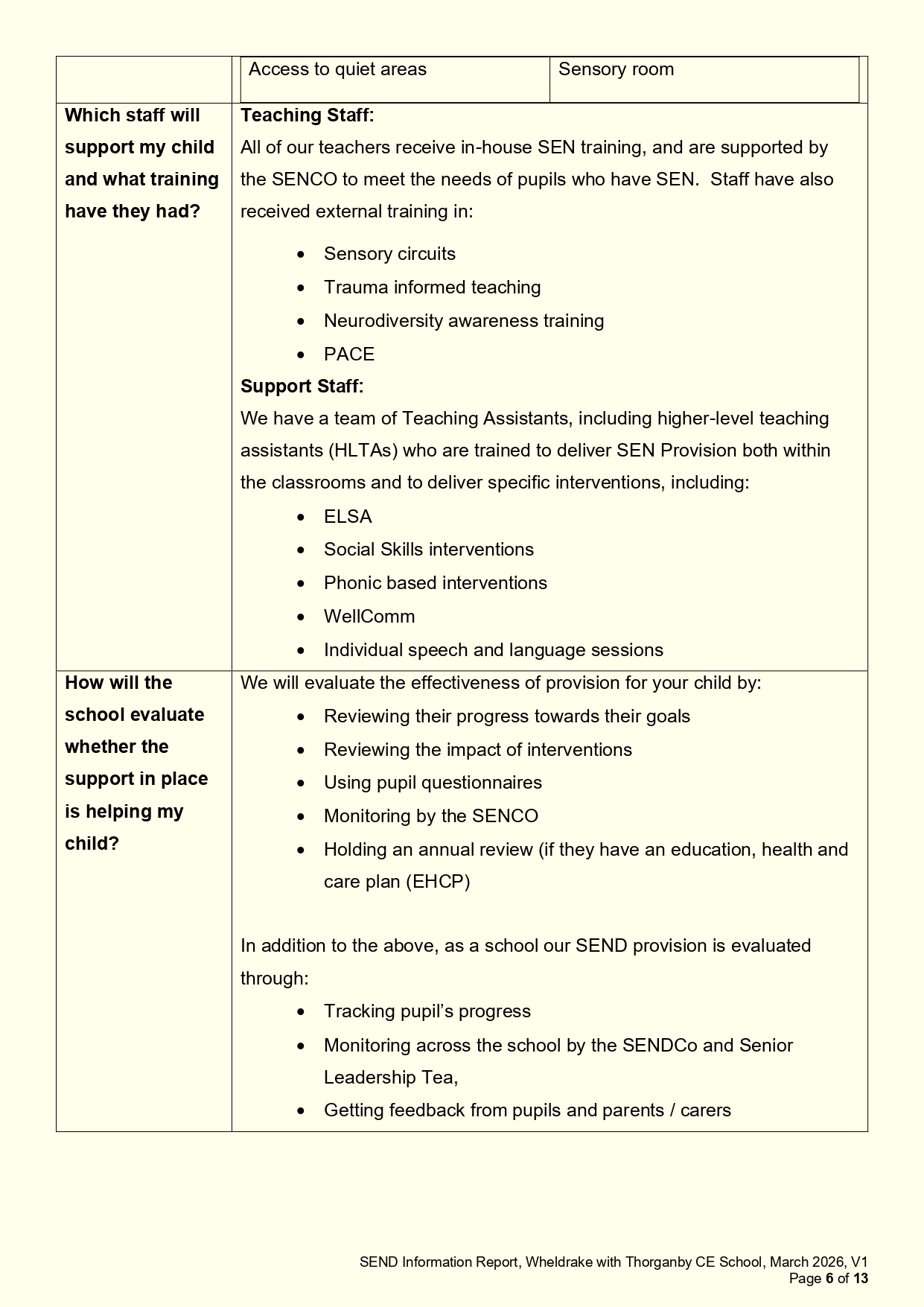
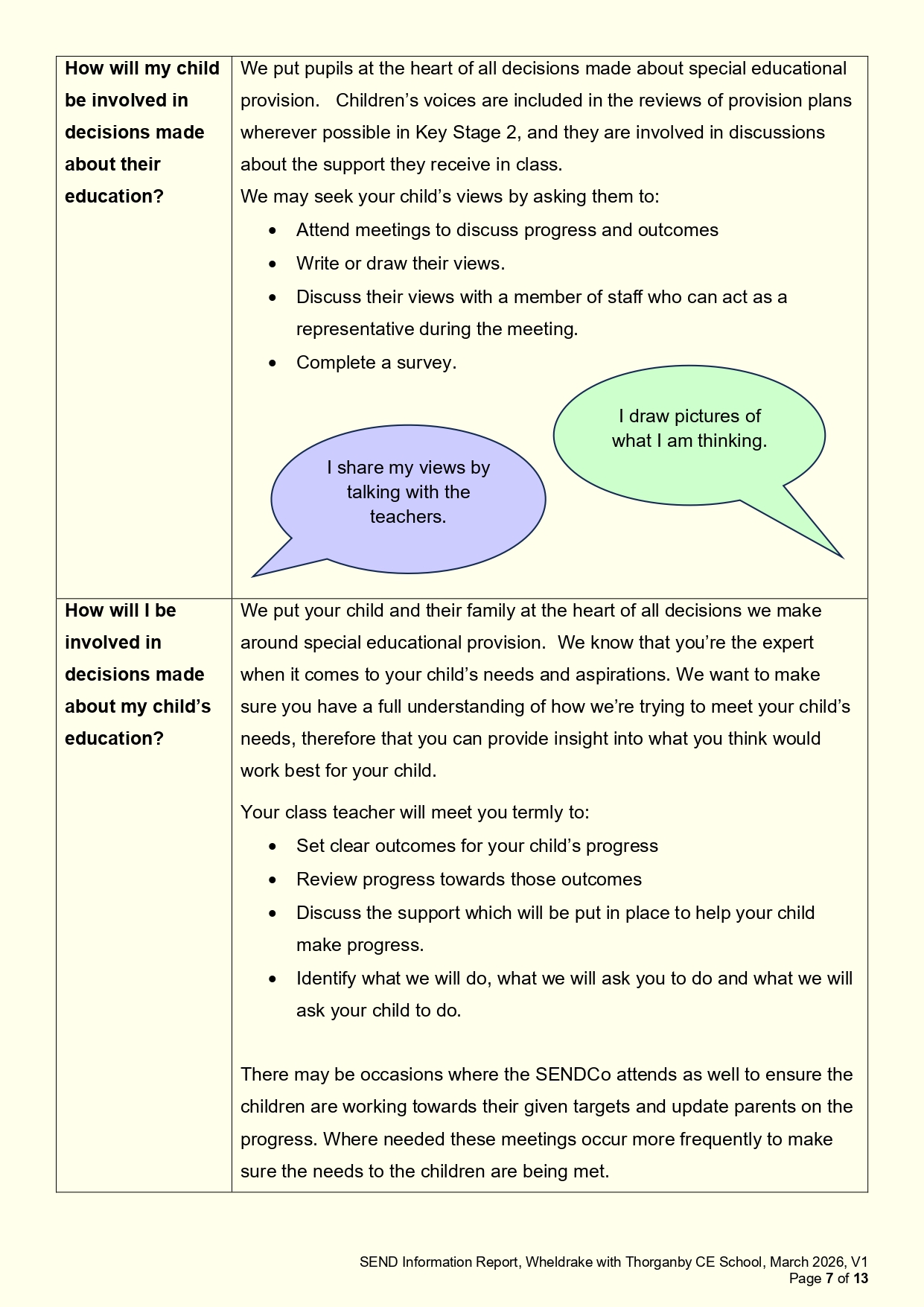
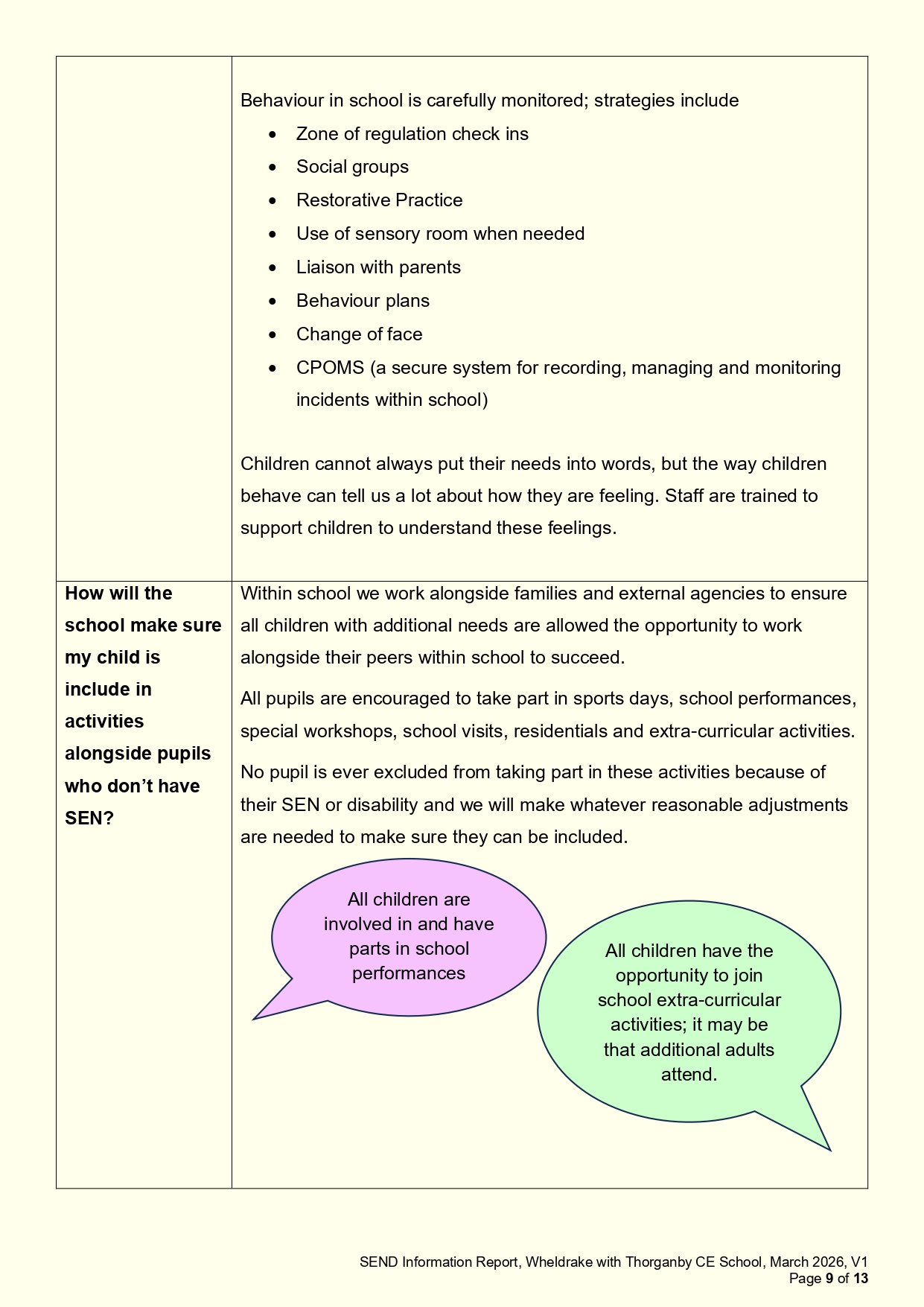
We aim for our children at Wheldrake with Thorganby CE Primary School to be resilient, kind, aspirational, happy and healthy. Our curriculum,  alongside our core Christian values of hope, faith and love, provide opportunities for all of the children to achieve this. We have high expectations of all pupils and we ensure that children with special educational needs are given the same opportunities to develop their own interests, develop a love of learning and to reach their full potential.

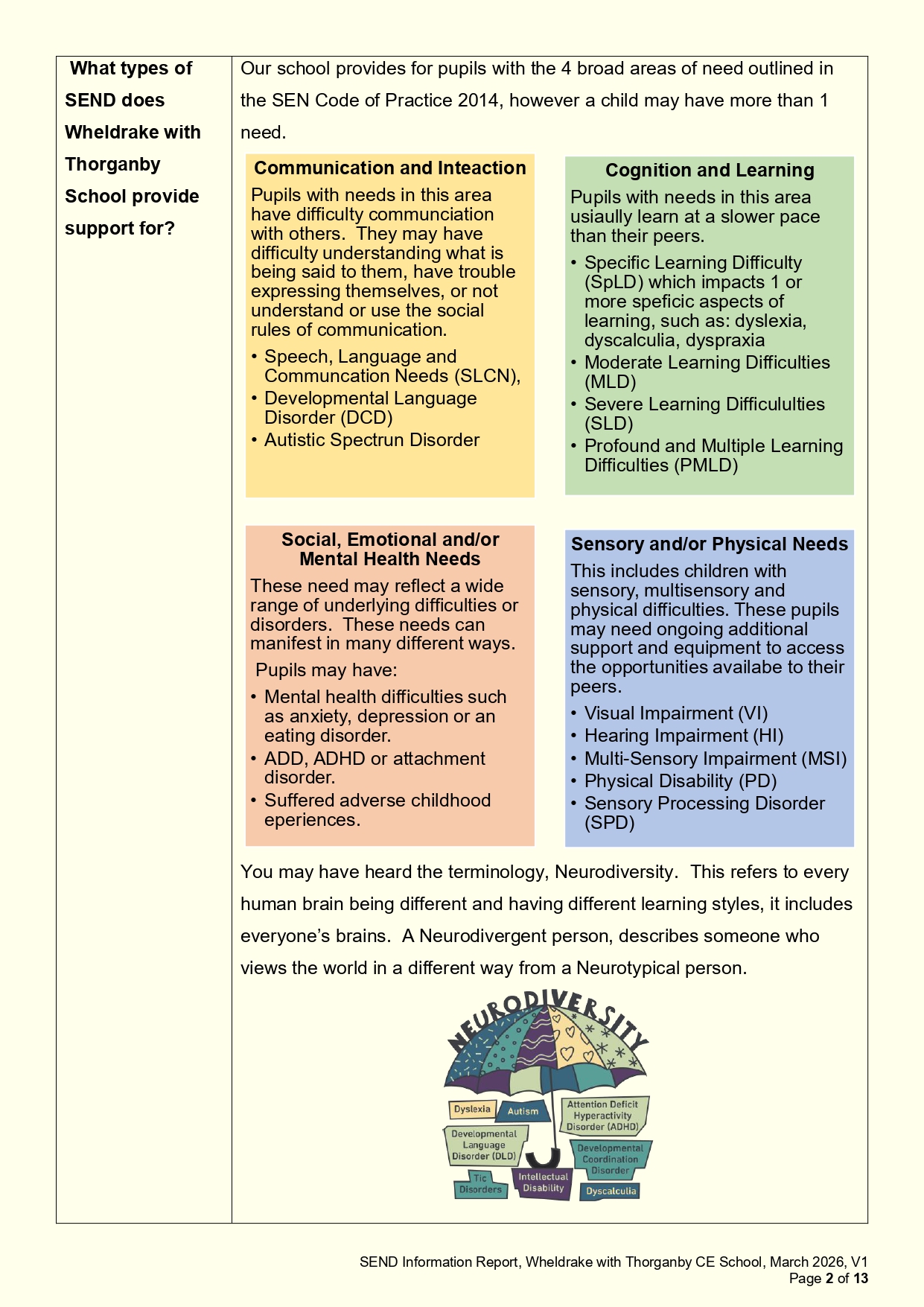
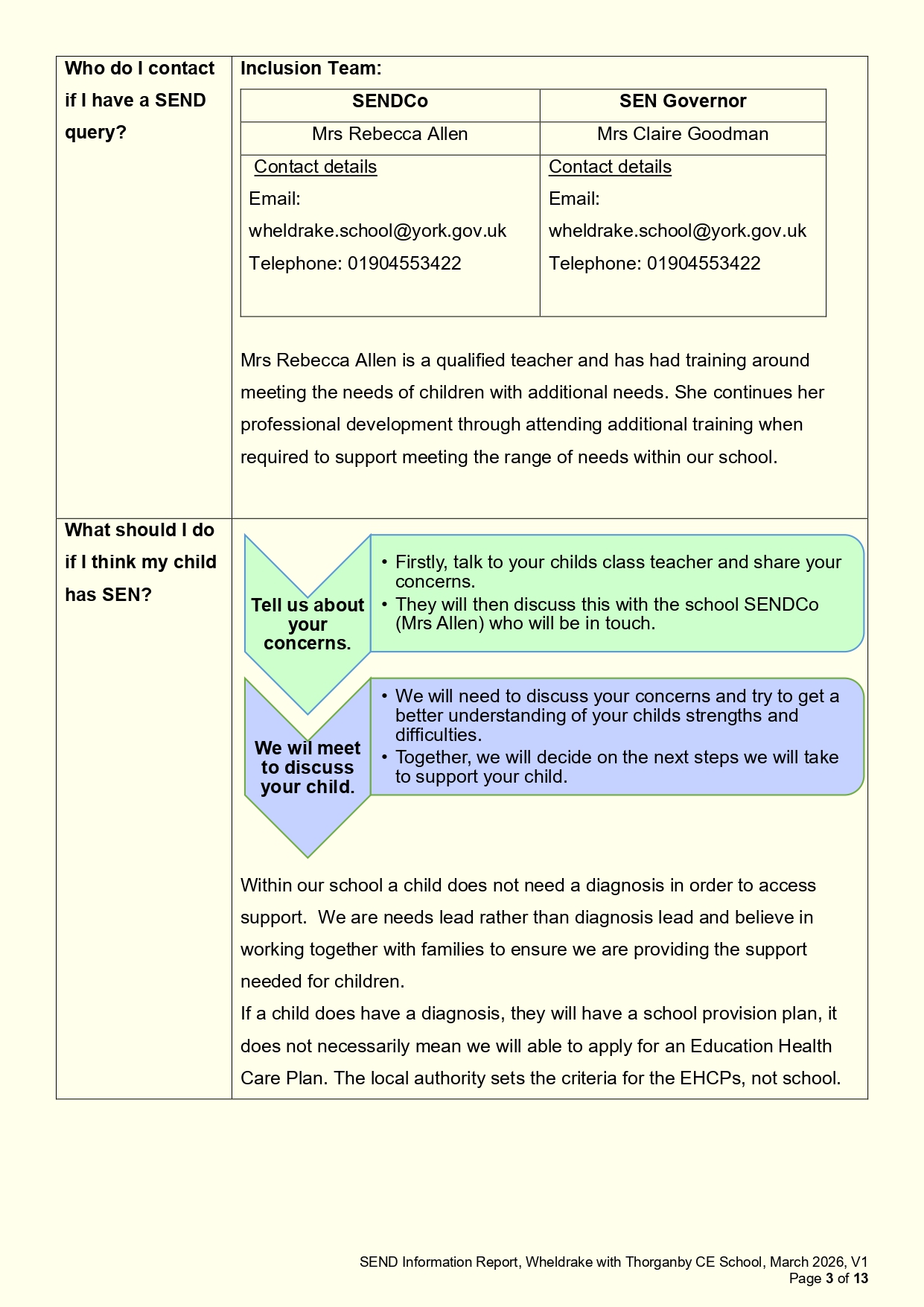
Our policy relating to Special Educational Needs and Disabilities can be found on our policies page. Our SEND report can be found below.

Mrs Allen is our Senco (Special Education Needs Coordinator) and can be contacted via our school email address.

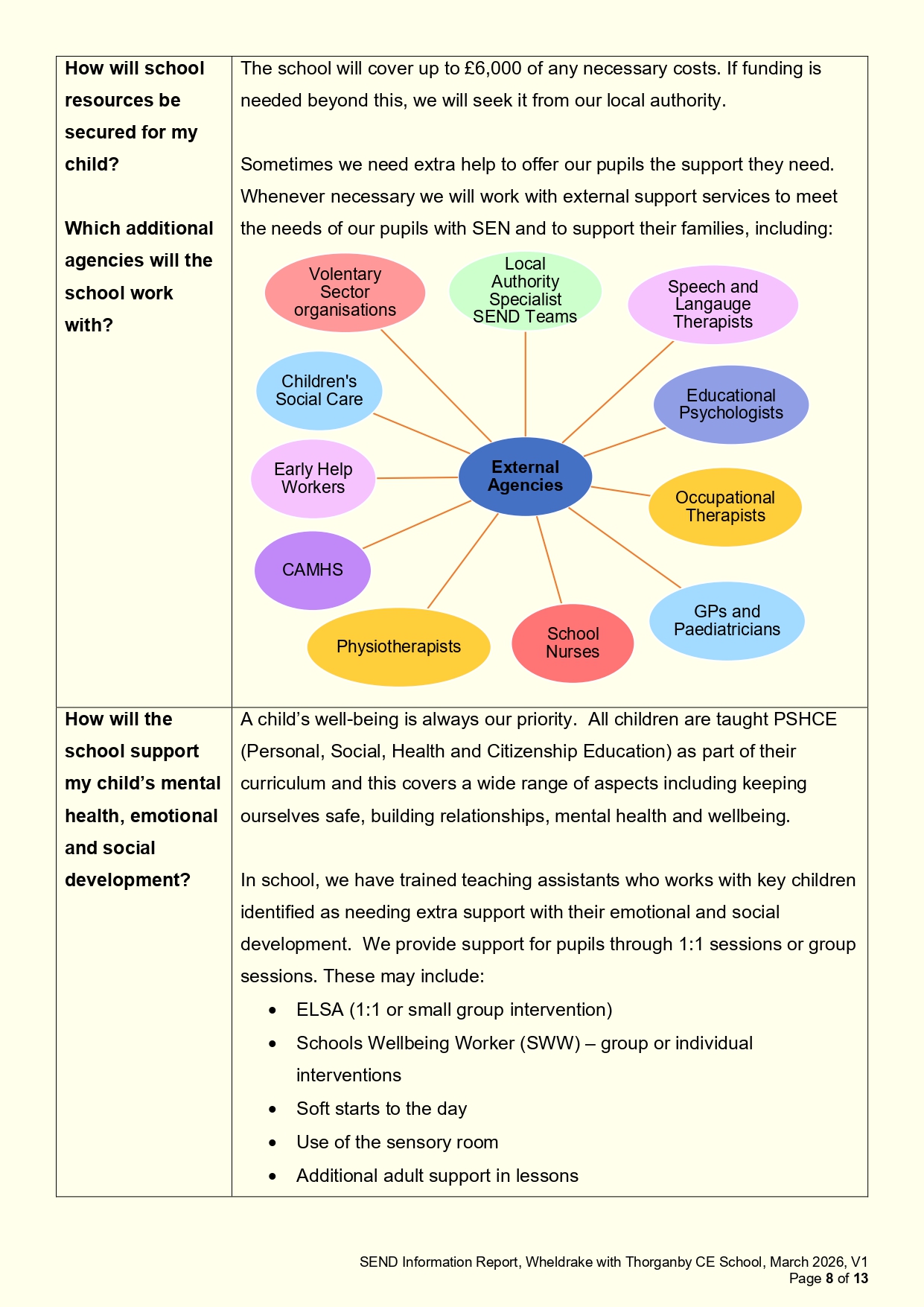
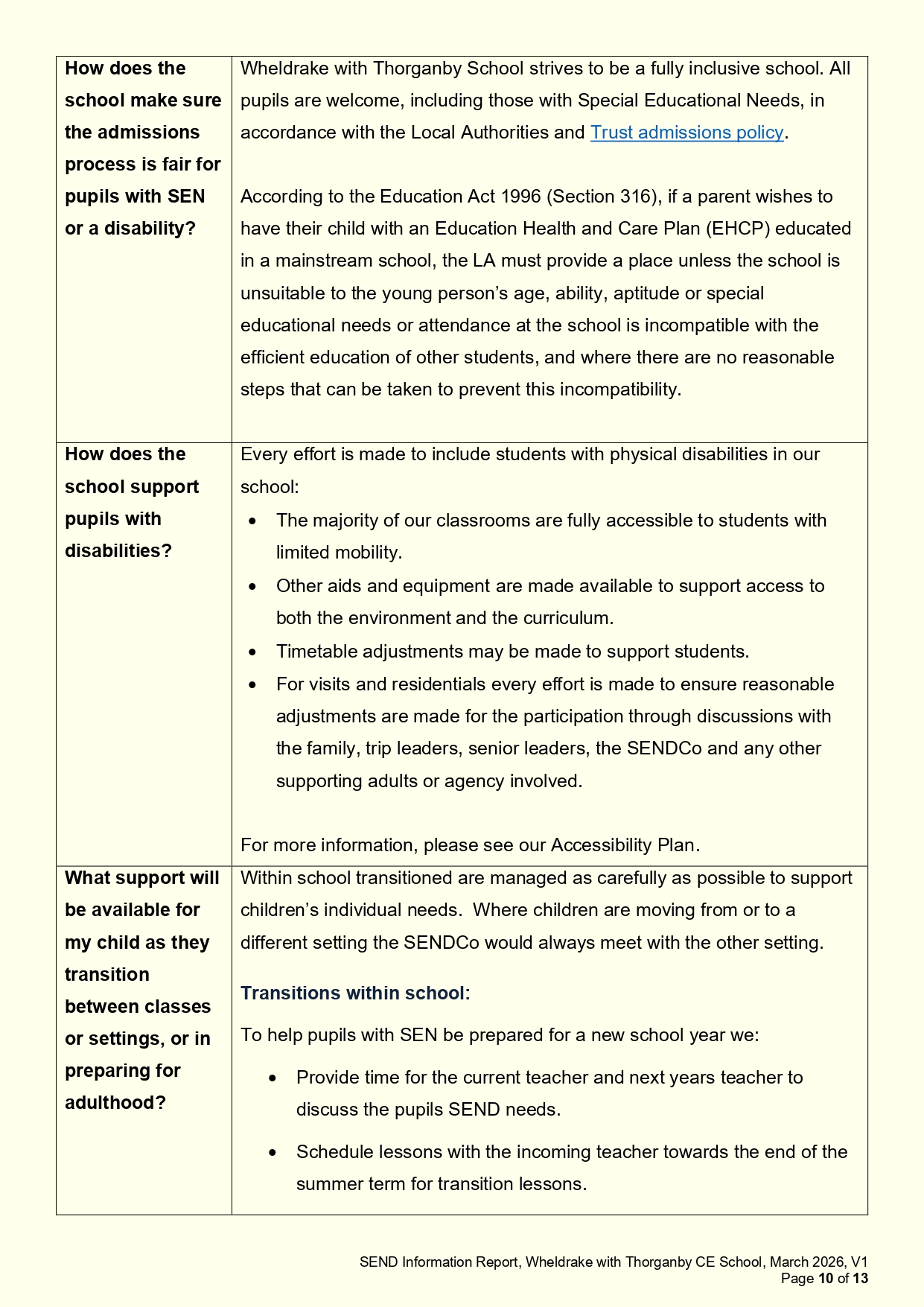
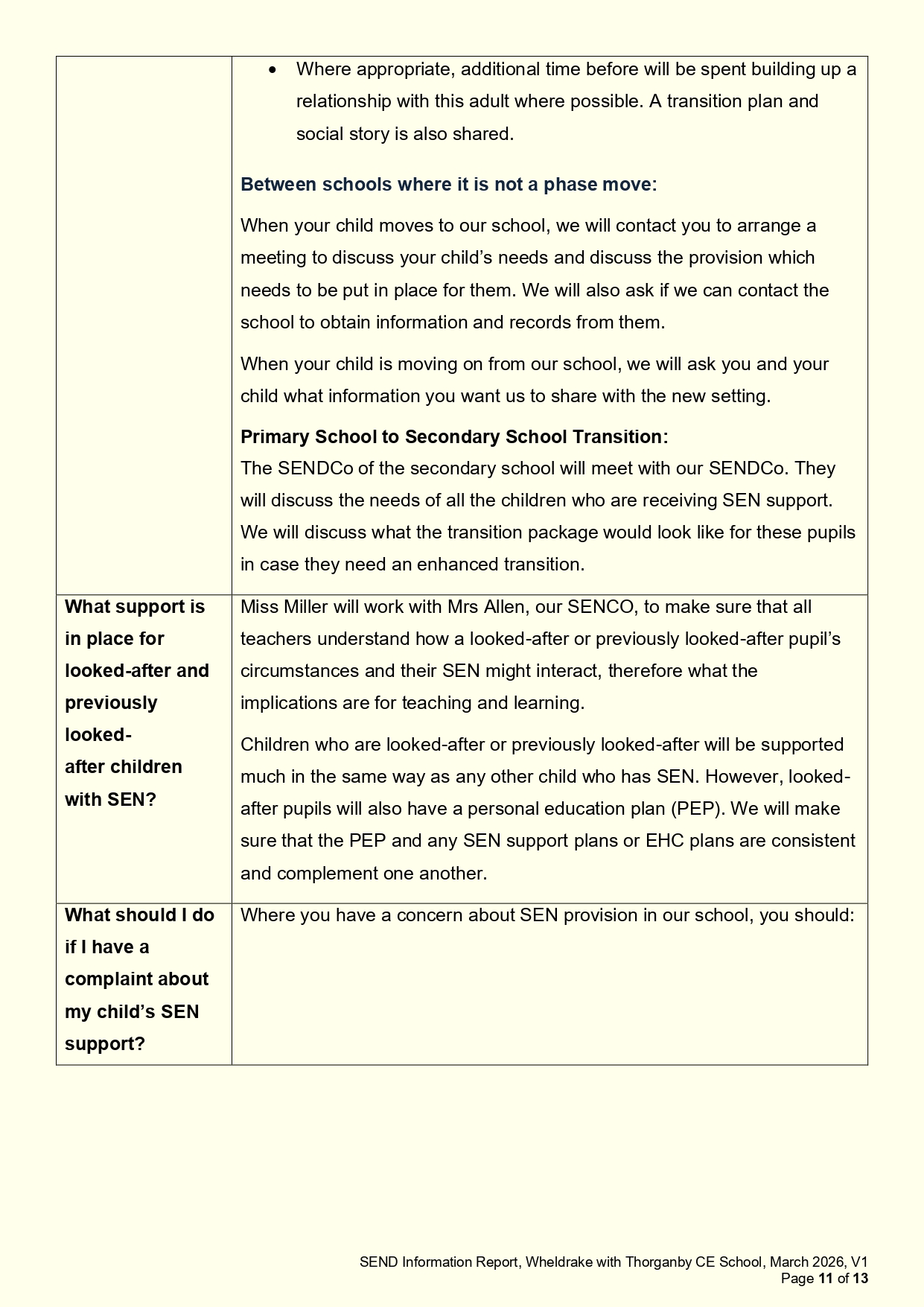
We hope that we can all work together to see your child make good progress.  If however you have a complaint about the way we have supported and helped your child, the following steps should be taken:

  • Discuss the matter with the class teacher and/or the Senco.
  • If the problem is not resolved arrange a meeting with the Head of School or Execute Head.  It may be appropriate for others to be involved in the meeting (e.g. the class teacher, Senco).
  • If the problem still remains unresolved you can meet with a representative of the Local Authority.  Contact a member of the SEN department on 01904 554320 or emailing SENdept@york.gov.uk to arrange this.

The City Of York Educational Psychology Service have produced a guidance leaflet on Emotionally Based School Avoidance (EBSA) for Parents and Carers. 

Please find the leaflet here: EBSA leaflet for Parents & Carers March 2022

The leaflet explores: – signs commonly associated with EBSA; links between anxiety and missing school; support at school and home; gaining pupil’s views and planning for the future.


PTA

Every parent and carer at our school is automatically a member of the PTA when their children start school. We are very fortunate to have a wonderful committee of dedicated and passionate people that help organise and plan fantastic events for our school community. The PTA raise funds for us to spend in school and also plans fun activities and events for everyone whilst doing so.
 
 
To keep up to date with all the recent news and events for the PTA, you could join their Facebook page.
 
If you would like more information about the PTA or would like to join, please contact them via this email address: pta@wheldrakewiththorganbyschool.co.uk

E Safety

What can you do?

  • Talk to your child about what they’re up to online. Be a part of their online life; involve the whole family and show an interest. Find out what sites they visit and what they love about them, if they know you understand they are more likely to come to you if they have any problems.
  • Watch Thinkuknow films and cartoons with your child. The Thinkuknow site has films, games and advice for children from five all the way to 16.
  • Encourage your child to go online and explore! There is a wealth of age-appropriate sites online for your children. Encourage them to use sites which are fun, educational and that will help them to develop online skills.
  • Keep up-to-date with your child’s development online. Children grow up fast and they will be growing in confidence and learning new skills daily. It’s important that as your child learns more, so do you.
  • Set boundaries in the online world just as you would in the real world. Think about what they might see, what they share, who they talk to and how long they spend online. It is important to discuss boundaries at a young age to develop the tools and skills children need to enjoy their time online.
  • Keep all equipment that connects to the internet in a family space. For children of this age, it is important to keep internet use in family areas so you can see the sites your child is using and be there for them if they stumble across something they don’t want to see.
  • Know what connects to the internet and how. Nowadays even the TV connects to the internet. Make sure you’re aware of which devices that your child uses connect to the internet, such as their phone or games console. Also, find out how they are accessing the internet – is it your connection, or a neighbour’s wifi? This will affect whether the safety setting you set are being applied.

Use parental controls on all devices that link to the internet, such as the TV, laptops, computers, games consoles and mobile phones.

Parental controls are not just about locking and blocking, they are a tool to help you set appropriate boundaries as your child grows and develops. They are not the answer to your child’s online safety, but they are a good start and they are not as difficult to install as you might think. Service providers are working hard to make them simple, effective and user friendly. You can find out more about setting parental controls by following the link here.

How to set parental controls using your service provider.

Setting controls on xbox, xbox live and xbox one.

Setting controls on Playstation.

Setting controls on a Nintendo device. 

Tips for setting controls on smartphones, gaming devices and internet enabled devices.

Further useful resources for parents:

Think you know – CEOP

Further support to keep children safe online.

BBC Stay Safe

Newsletters